


When Sally Laverty was in her early 70s, she travelled from Saskatoon to Ireland to care for her brother, who was dying of cancer. During the months they spent together, he asked why she didn’t run anymore.
Laverty, now 81, had loved running before she became a mum. “After, the only running I was doing was to hockey games and soccer games with my kids,” she says. Her brother began chasing her out the door each morning, encouraging her to get moving. Laverty walked daily and took part in the local parkrun. When she returned to Saskatoon after her brother’s death, she continued her walking regimen, often covering more than 15km a day along the Meewasin trails and becoming a fixture at the Mendel Riverbank parkrun.
As walking became an important part of her life, Laverty remembered a conversation she’d had with a friend three decades earlier who had walked part of the Camino de Santiago, a network of ancient pilgrimage routes leading to the city of Santiago de Compostela in northwest Spain. “I was just flabbergasted. I couldn’t believe how wonderful it would be to do it,” Laverty says. “I thought it would be so interesting to walk from one country to another, to cross through the Pyrenees Pass and to meet so many people that were on the same journey … I knew I had to do it before I got any older.”

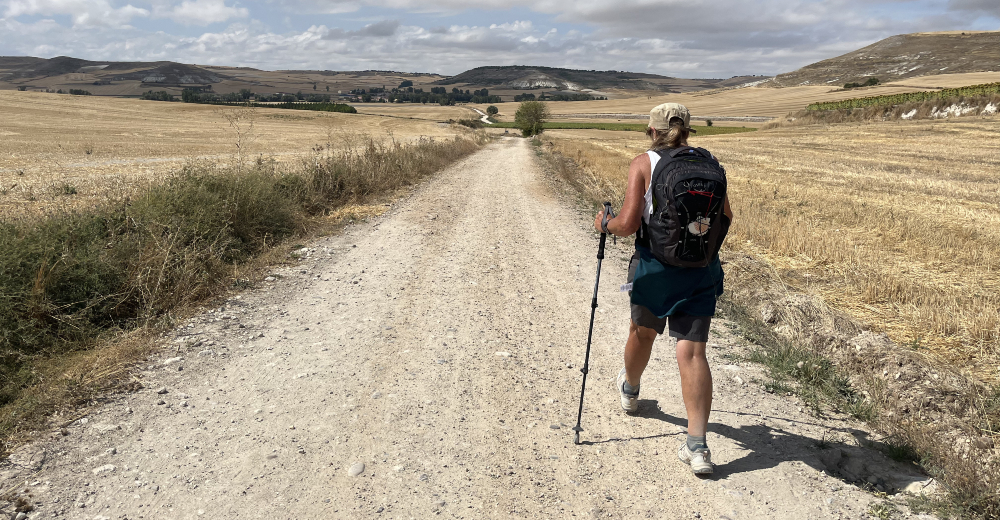
So, this past summer, Laverty and one of her daughters travelled to Saint-Jean-Pied-de-Port in France and walked nearly 800km to Santiago de Compostela over the course of a month. Armed with walking poles and daypacks, the pair averaged 25km a day, shipping their luggage ahead to each destination.
Though the daily distance was a significant step up for Laverty, she never doubted she could finish. “I stayed focused and I knew I could do it – I knew I could walk that distance because I could go down to the river and I could walk and not stop walking unless someone told me you’ve got to stop … But I’m not saying it was easy because it wasn’t; there were a lot of difficult areas where we walked and where we climbed the mountains.”
Sally’s daughter, Eileen Laverty, said she could catch her mother on the uphills and downhills, but Sally led the way on straightaways. “She clips along at quite a pace,” Eileen says.

“Not to boast or anything, but people we met on the Camino didn’t believe that I was 80,” Sally says.
Throughout the journey, Sally and Eileen alternated between chatting and walking side by side in meditative silence. (“We walked in silence when we came to a giant hill,” Sally says. “I told Eileen not to talk to me, that I needed to focus.”) They explored the small villages along the route, visited cathedrals, marvelled at the scenery and met walkers from around the world eager to share stories and always lend a helping hand.
“There’s such a sense of spirit and camaraderie,” Eileen says. “The Camino is about the journey itself. It’s about the walking, it’s about the people you meet, it’s about all those great experiences, the fellowship, meeting people and sharing the journey together. For me, especially, it was about recognizing the lessons of the Camino that everyone talks about: That you can live with very little and you just get in a rhythm of life and focus on the joy.”

The Lavertys arrived in Santiago de Compostela at the end of September with full hearts and, remarkably, not a single blister. “To be quite honest with you, when I finished the walk in Santiago I said: I could walk another 800km. I felt the peak of my health when I finished the Camino,” Sally says.
The 800km trek is likely far beyond what Sally’s brother imagined when he first encouraged her to start walking, and Sally is sure he’d be proud of what she accomplished. She even felt him with her, pulling her up the most challenging climbs.
“It was one of the highlights of my life – I’ll never forget it,” she says. “I would love to do another Camino – I would just love to be another 40 years younger and then I wouldn’t mind climbing the mountains again.”


