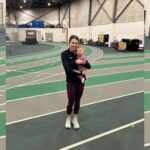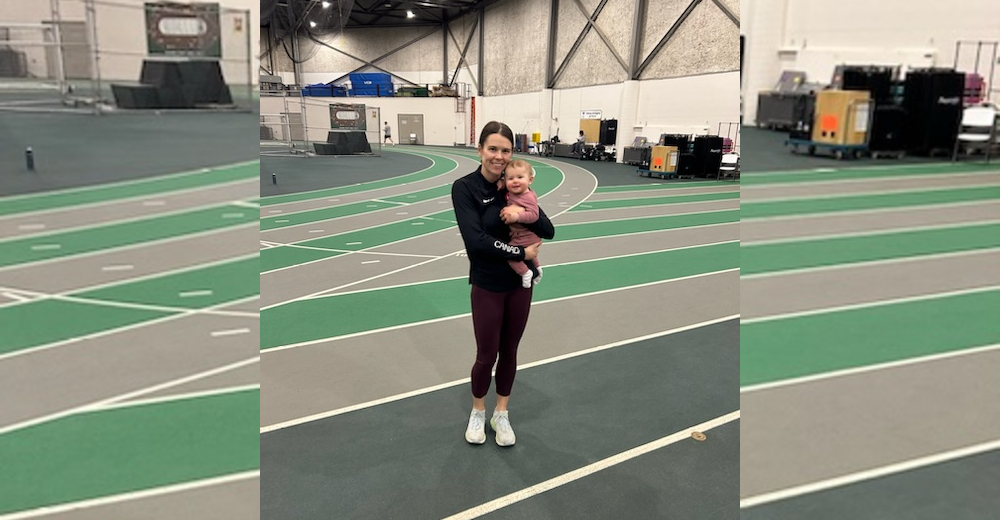


Less than a year after making her Olympic debut at the 2024 Paris Games, Saskatoon hurdler Michelle Harrison began a different chapter: motherhood.
Harrison, 33, has been competing in track since high school and earned her first senior national team spot in 2022. She arrived in Paris in peak form, but was among several Canadian athletes sidelined by a stomach virus and did not advance from the heats in the 100-metre hurdles. Weeks later, her focus shifted again — she was pregnant. She gave birth to her daughter, Isabella, last June.
After a challenging pregnancy and postpartum period, Harrison has returned to the track for unstructured training with a renewed love of running.
This week, Harrison speaks with the Brainsport Times about pregnancy, early motherhood, burnout, and how she’s thinking about her future in elite sport.
You’ve long been an athlete with aspirations tied to a four-year Olympic cycle. How much did that shape decisions about when or whether to start a family?
It was a huge part of it. I got sick at the Olympics and, because of that, I felt like I really needed a break. I felt burned out and I was thinking that four years is such a long time to go to the next Olympics. I was like: I just don’t think I am there in this moment.
I also didn’t want to put off having a family for another four years because it’s not like when you decide to have a baby it happens the next day; sometimes it takes years- you just never know.
How are you viewing your future in high-level athletics at this point?
It’s a big question mark.
I wanted to end my track career on a good note and, in a way, I did by making the Olympics as that was my ultimate goal ever since I was little. But, getting sick kind of put a damper on it. So there is that thought in the back of my mind about coming back now. There are some hurdlers I look up to that ran some of their fastest times in their mid thirties after having children.
However, It did take me a long time to even consider it. During my pregnancy and the first little bit after giving birth I was like: I’m not going back. My pregnancy and the first little bit postpartum were really tough and I really did not exercise very much. I was like: There’s no way I’m going to be able to get back physically. But, at the same time, I kind of missed it and I think, because of my sickness and not achieving my goals at the Olympics, at the end of the day I knew there was so much potential that was left. One of my best practices was my last big workout before getting sick. I was also having some breakthroughs in practices earlier in the year that didn’t end up translating into races in time.
Goals aside, I am just enjoying getting back in shape with my daughter. I was struggling being at home all day and getting back out on the track working out with my daughter by my side has made my days a lot brighter. I’m going to explore the possibility of maybe coming back and seeing if I can work my way back up before the 2028 Olympics, but that’s a big question and I’m not going to put any expectations on it. This is going to be a big: Just see how it goes.
What was your relationship with sport throughout your pregnancy?
I found it extremely uncomfortable to run through pregnancy. I don’t know if it was the way my baby was sitting, but there was something up with my bladder that I found hard to push through. I did a little bit of weight lifting and tried to stay active when I could but, at the same time, I took a nice break post-Olympics. I didn’t really have any sort of structure. I was just doing what I felt like in a moment.
That definitely hadn’t been the plan. I didn’t really know what to expect and I feel like everything with pregnancy and having a baby was a big learning curve. It definitely was a humbling experience. I definitely thought I would be able to do a lot more both during pregnancy and after giving birth. I thought I’d be out walking with my baby the week after and no, that was not the case.
The biggest thing I learned is that everybody’s so different. My experience was so different from my other friends’ and what I’ve heard from other stories. No pregnancy is the same.
Did pregnancy in any way change the way you think about your body after years of training it for elite performance?
It showed me that our bodies are capable of so much more than I realized. The whole journey of pregnancy and giving birth is such a huge thing and it just makes me realize how powerful the woman’s body actually is.
Were there moments during pregnancy when your athletic mindset helped you feel confident, or moments when it made things harder?
Honestly, I think being pregnant is harder than being an athlete. I think I almost had to let go of my athletic mindset a little bit. I had to let go of the control and structure I am used to and just let my body do its thing. For example, if my body wanted rest, I would just let it rest. I felt uncomfortable pushing the limits with a baby inside of me.
When you say you struggled with pregnancy, what was most challenging?
Not being able to be as active as I was used to, having a different body, morning sickness, and being tired all the time. I wasn’t able to keep up with the lifestyle I was used to which was tough and I was also way more tired while pregnant than I was with a newborn. Not sure why, but I did not feel myself through pregnancy.
In the early postpartum months, how did you navigate the tension between wanting to move again and respecting recovery?
I just focused on trying to heal myself and not push it. If I noticed symptoms that I was taking things a little bit too hard I tried to cut back and just let my ego go a little bit and just take care of me first.
I’m a busy person – I like to be constantly doing something and, during that time, I really had to focus on just sitting down and relaxing, letting the housework go and not going out to the store. That was kind of the hardest part.
At the beginning of December I got a Field House membership and I’ve been doing something, but it’s not anything structured yet – just getting moving. Before that I was very gradual over the summer; I just tried to walk every day and that was my biggest thing to keep active. I eventually tried to work my way back up to running, which was a roller coaster. There was no structure to it; one day I’d just go out and see how I felt and, if it went well, I’d just keep doing something and, if not, I’d rest instead. I felt like one day would be good and the next day I couldn’t do anything. I just thought it’d be a lot smoother of a return, that each day would get better, but it really wasn’t. My hips are still sore and I’m hoping they’ll get better with time.
What has surprised you most about your body or mindset as you’ve returned to moving after having a baby?
The biggest thing is that I’ve learned is that track is something I genuinely enjoy doing.
Returning after baby I tried a bunch of different things fitness wise and I wasn’t liking things too much and I realized I really like track. It wasn’t something I did for accomplishment purposes – I actually like it. It is something I love to do. And why do I need to be done if it’s something that I enjoy? No matter if I make it back to the Olympics or not, why not continue running?
There are athletes that continue running after having children, but there’s lots that don’t and I feel like there’s a pressure to just move on with your life afterwards. But if I can keep up a level of training with my current lifestyle, why not?
Izzy is going to grow up seeing her mum training and chasing big goals. Why is that so important?
That’s one of the reasons why I didn’t want to go back at first – I didn’t want track to take me away from my time with her. But going to the track now with her I realize: This is something cool we can do together.
I once posted a video on social media of me doing weights with her attached to me and (someone I met in through competition) commented on my video something along the lines of “I can’t wait to see you competing in the 2028 Olympics with your baby in the stands.” That stuck with me. I was like: That would be a really cool experience. I kind of want to do it for her too, not just for me. It’s something we can do together and I can be a positive role model for her.